
Ziyana Yachts: connecting a technical audit to a content plan
The diagnostic work for Ziyana Yachts produced three connected reports: a technical audit, a keyword strategy, and a content-and-visibility analysis. The objective was to examine how the website’s commercial pages and destination content could support relevant search journeys.
Work produced: three reports dated June 2026. Project boundary: analysis and recommendations; the supplied record does not establish implementation or subsequent ranking, traffic or booking changes.
The central question: can visitors move from inspiration to the right charter information?
The source reports examine fleet pages, events, destinations, itineraries and the company introduction. These pages serve different needs. Someone comparing yachts needs usable fleet information; someone planning a destination may first need practical guidance. The content strategy is most useful when it connects those needs instead of asking every page to target the same broad charter query.
The technical audit recorded a fleet-page concern: the retrieved HTML contained a loading message rather than complete listing content. That is a reason to investigate rendering and accessibility. It is not sufficient evidence to conclude that Google indexed no yachts. The diagnostic should be followed by rendered-page inspection and the site’s own search information before treating that observation as a confirmed indexing failure.
A real excerpt from the page-targeting work
Actual keyword-to-page excerpt, reflowed. Estimated volume, competition and priority columns omitted; recommendations are not results.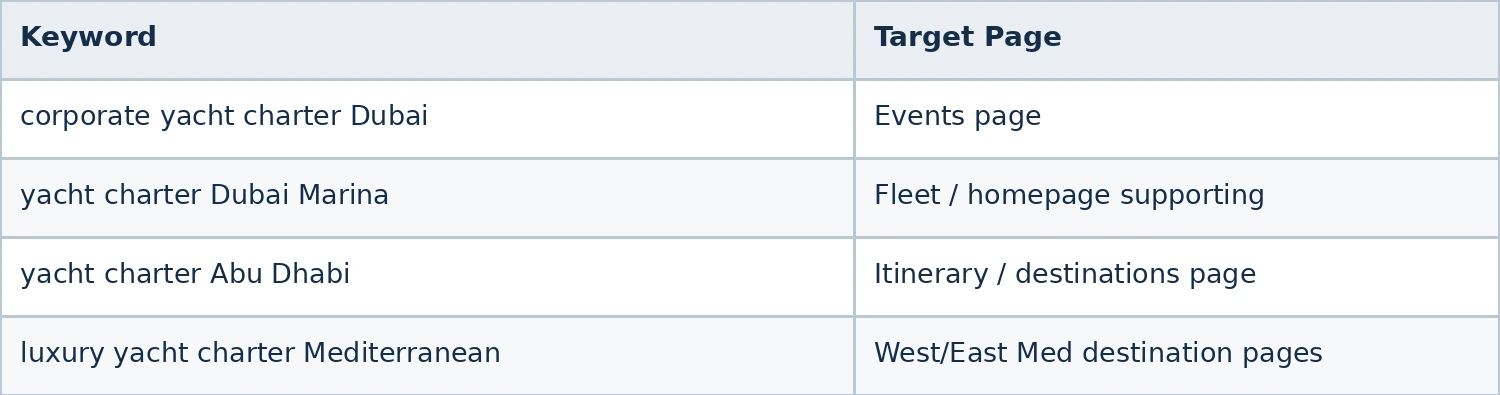 Open full size
Read excerpt as text
Keyword Target Page corporate yacht charter Dubai Events page yacht charter Dubai Marina Fleet / homepage supporting yacht charter Abu Dhabi Itinerary / destinations page luxury yacht charter Mediterranean West/East Med destination pages
Verbatim selected cells from the strategy report, reflowed for readability. Estimated-volume, competition and priority columns are omitted. These are proposed targets, not achieved rankings.
| Keyword | Proposed destination in the original report |
|---|---|
| corporate yacht charter Dubai | Events page |
| yacht charter Dubai Marina | Fleet / homepage supporting |
| yacht charter Abu Dhabi | Itinerary / destinations page |
| luxury yacht charter Mediterranean | West/East Med destination pages |
The mapping demonstrates how the research was organized. It also exposes a refinement worth making: “Fleet / homepage supporting” is still a broad assignment. Before implementation, I would define one primary destination for each intent and make the supporting role of adjacent pages explicit. This is an editorial refinement to the plan, not a change already delivered to the website.
Turn the findings into page-level decisions
| Page family | Job for the visitor | Proposed decision | Evidence needed before implementation |
|---|---|---|---|
| Homepage | Understand the business and choose a route | Explain the offer, then direct visitors to fleet, destinations or occasions | Confirmed services, market coverage and enquiry priorities |
| Fleet | Compare available options | Validate listing rendering, meaningful details and navigation to individual yachts | Rendered pages, inventory availability and search data |
| Events | Find a charter for a specific occasion | Organize useful occasion content around real services | Actual event offerings, constraints and relevant customer questions |
| Destinations and itineraries | Plan a voyage | Link practical guides to suitable fleet or enquiry routes | Verified routes, seasonality and service availability |
This table is a new synthesis of the existing reports. It makes the proposed execution easier to review; it does not represent a newly completed implementation.
Prioritization: resolve dependencies before expanding the content library
I would first validate the fleet experience and commercial paths. Producing more guides while the browsing or enquiry journey is unclear would make the content plan harder to evaluate. The next stage is page-purpose mapping: distinguish the homepage from fleet browsing and decide where occasion and destination queries belong.
Content production can then be prioritized using actual demand and business knowledge. The source reports suggest a charter-pricing guide, destination content and occasion pages. Those are useful briefs to investigate, but prices, availability and service promises need confirmation from the business. Search-volume estimates in the original report are directional and are not presented here as verified demand.
The original reports also contain strong claims about competitor gaps and likely ranking timelines. This portfolio does not repeat those as established facts. A defensible recommendation should survive even when an optimistic forecast is removed: does the proposed page answer a real customer question, have a clear purpose and connect to a relevant next action?
What a handover should make testable
For each recommendation, I would record the affected URL, current observation, proposed change, required access and acceptance check. For the fleet concern, the check would examine what content is available and how important URLs can be discovered. For content mapping, the check would ensure that published pages match their agreed purpose and links lead to the intended commercial destinations.
Results would then be evaluated against a saved baseline, rather than inferred from the existence of new copy. That follow-through is outside the supplied diagnostic evidence, so there is no invented “results” section or claim of recovered traffic.
What this study demonstrates
The value of the work is the connection between technical investigation and practical content decisions. It shows how an audit observation can lead to a validation task, a page-level decision and a clearer brief without treating an untested assumption as a proven problem.
For a project with implementation and historical reporting, view the Klimastål case study. For a different diagnostic problem, view the technical audit assignment.