
Klimastål: SEO and WordPress work, with the evidence in view
I worked across SEO, website content and WordPress management for Klimastål, a Norwegian ventilation supplier. This case study brings together the original performance reports, search snapshot and saved homepage content, so the work can be assessed alongside its supporting evidence.
Role: SEO Specialist & WordPress Webmaster · Engagement: 2022–2025 · Market: Norway · Platform: WordPress, Astra and Elementor
At a glance: historical desktop PageSpeed performance 68 → 96; a reported 460 search impressions and 14 clicks in one 28-day window; 2,011 unique domains in a prospect-research export.
These are different measures from different sources. They are not a combined growth score, a revenue result or a controlled test of one intervention.
A website with two connected jobs
The website needed to explain ventilation products and services while helping prospective customers find the information relevant to their requirements. My work connected the website itself with the research and reporting around it: reviewing technical issues, working on Norwegian product-category copy, maintaining pages and examining the available search data.
The initial performance assessment provided a concrete starting point. The desktop test recorded a performance score of 68 and a Largest Contentful Paint of 3.3 seconds. The accompanying recommendations covered image delivery, render-blocking resources, fonts and caching. These were useful implementation questions, rather than a reason to treat the overall score as the entire project.
The saved mobile assessment also showed a weak experience, but its screenshot and written summary disagree on some measurements. I have therefore excluded a mobile before/after improvement claim. The strongest comparable evidence in this folder is the sequence of desktop captures presented below.
What I worked on—and what the record can show
| Workstream | My contribution in the project record | Supporting material |
|---|---|---|
| Website and content | WordPress page work and expanded homepage product-category content | Saved homepage captures and the authored engagement report |
| Technical assessment | Performance review and an optimization action list | Initial assessment and subsequent PageSpeed reports |
| On-page research | Keyword research and title/description drafts | Keyword files and copy documents |
| Monitoring | Review of performance and search reporting | PageSpeed and Site Kit captures |
| Off-page research | A categorized prospect database | Original 2,011-domain CSV export |
A later screenshot can confirm that a page or score existed. It cannot, by itself, establish every configuration change that led to it. The folder does not contain a deployment log covering all the technical recommendations, so I keep the observed results separate from unverified claims about individual fixes.
Desktop performance: three original checkpoints
The reports below are embedded evidence, not recreated dashboard graphics. Open each image at full size to read the device selection, measurement and available timestamp.
Initial desktop assessment
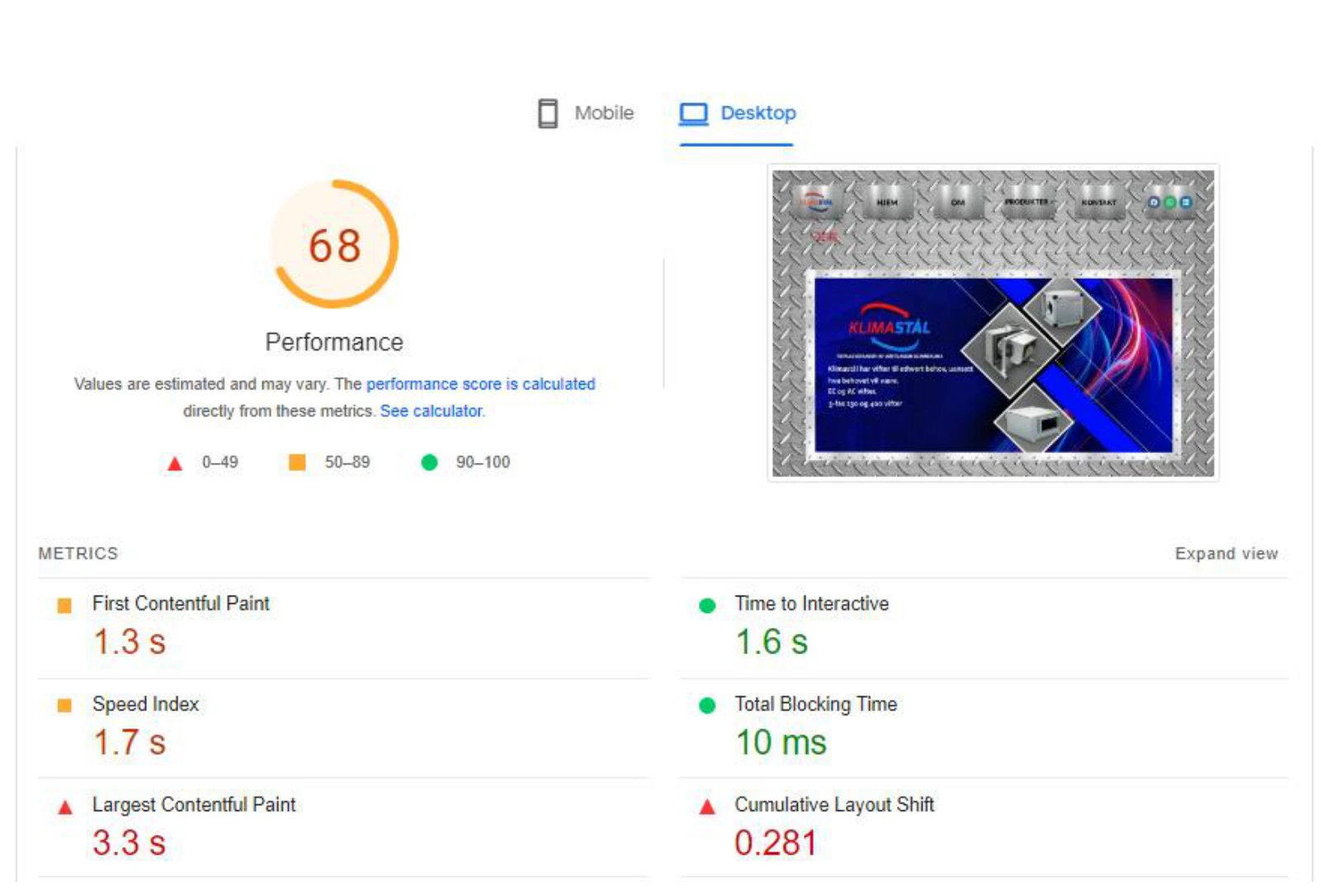
Initial desktop assessment: performance 68/100 and LCP 3.3 s. The engagement summary dates this baseline to April 2022; the visible screenshot itself does not show a test timestamp.
The starting report is useful because it identifies a specific page-loading concern rather than simply showing an unfavorable score. It also provides an important consistency check: the original screenshot displays CLS as 0.281, while the written assessment rounds or records it differently. I use the original LCP and performance values here and avoid a disputed CLS comparison.
6 September 2024
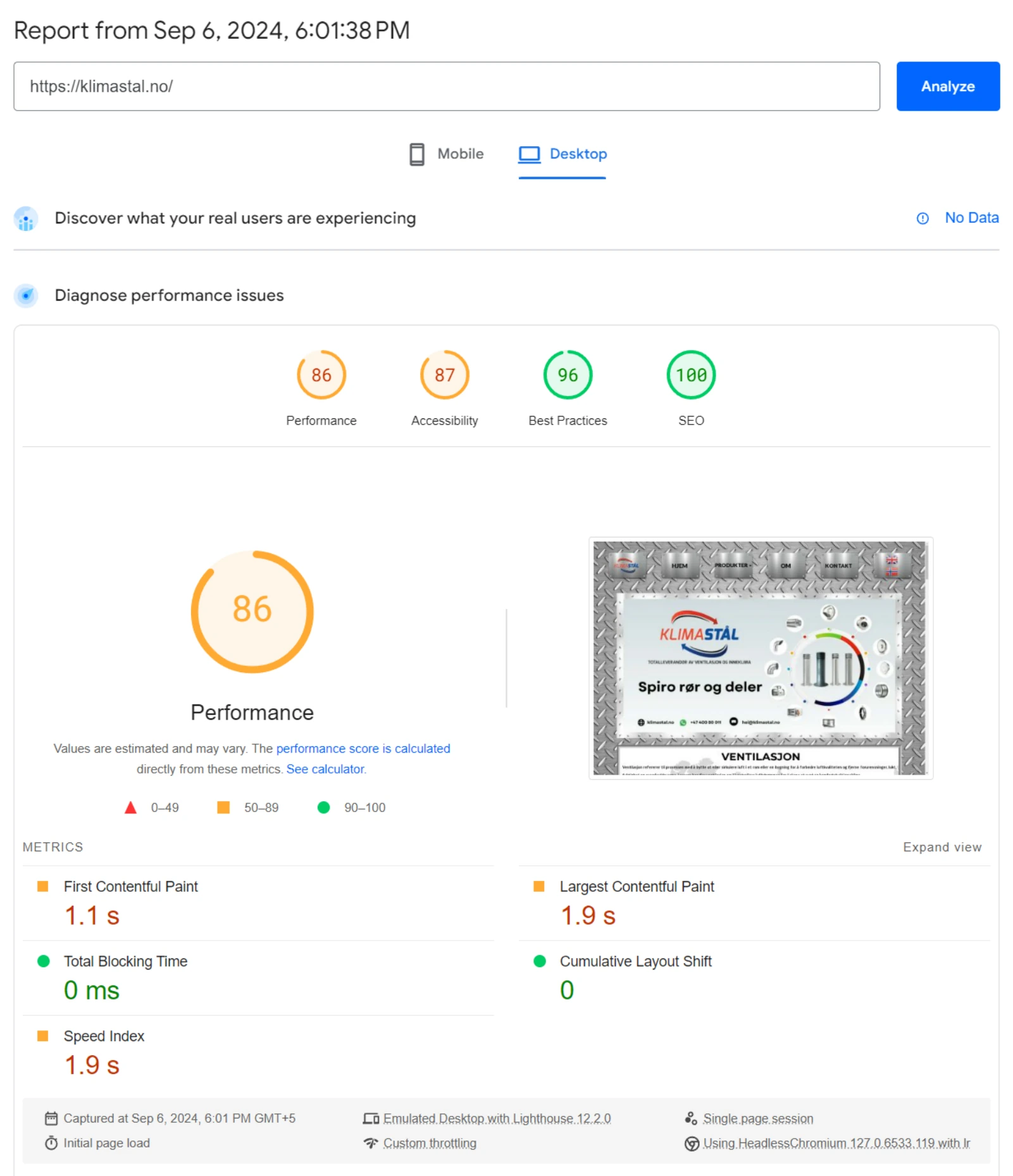
6 September 2024 · Desktop lab test · Performance 86/100 · LCP 1.9 s.
This checkpoint shows a stronger desktop result than the initial assessment. It still contains image-delivery recommendations, demonstrating why a better headline score should not end the optimization review. The remaining opportunities matter independently of whether the score looks satisfactory.
1 October 2024
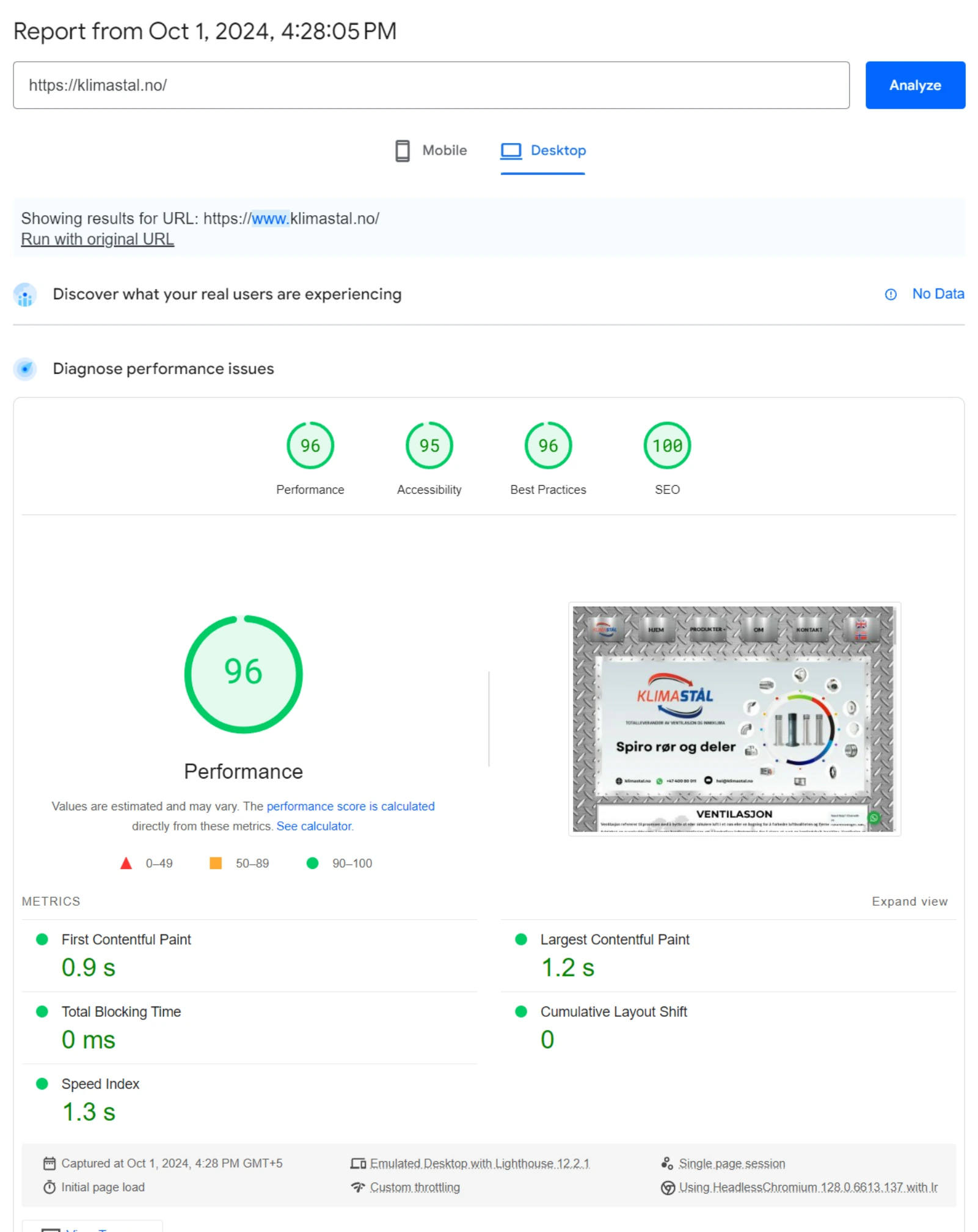
1 October 2024 · Desktop lab test · Performance 96/100 · LCP 1.2 s. The report has no field-data result.
| Capture | Device | Performance | LCP |
|---|---|---|---|
| Initial assessment | Desktop | 68 | 3.3 s |
| 6 September 2024 | Desktop | 86 | 1.9 s |
| 1 October 2024 | Desktop | 96 | 1.2 s |
Across these captures, performance increased by 28 points and the recorded LCP decreased by 2.1 seconds. These are arithmetic differences between historical observations. They do not isolate the effect of a particular change: page content, testing conditions and tool versions can vary. The result does not establish that mobile performance improved by the same amount or that all real visitors experienced these timings.
Homepage content: from a supplier-led introduction to a clearer explanation
The content work covered six product areas: ventilation, spiral ducts and parts, ventilation systems, ventilation units, extraction hoods and extraction fans. The evidence shows substantial Norwegian-language copy organized into those categories.
The two saved versions below allow a narrower, useful comparison of the ventilation introduction. The earlier file is undated and already contains expanded content; it is not a verified pre-engagement baseline. The later capture is dated 2 June 2025.
Earlier recorded version
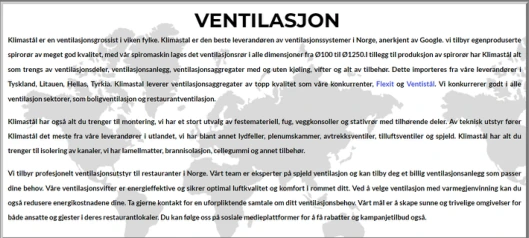
Earlier saved copy, date not shown. The opening emphasizes the supplier, products, sourcing and commercial offering.
Recorded version from June 2025
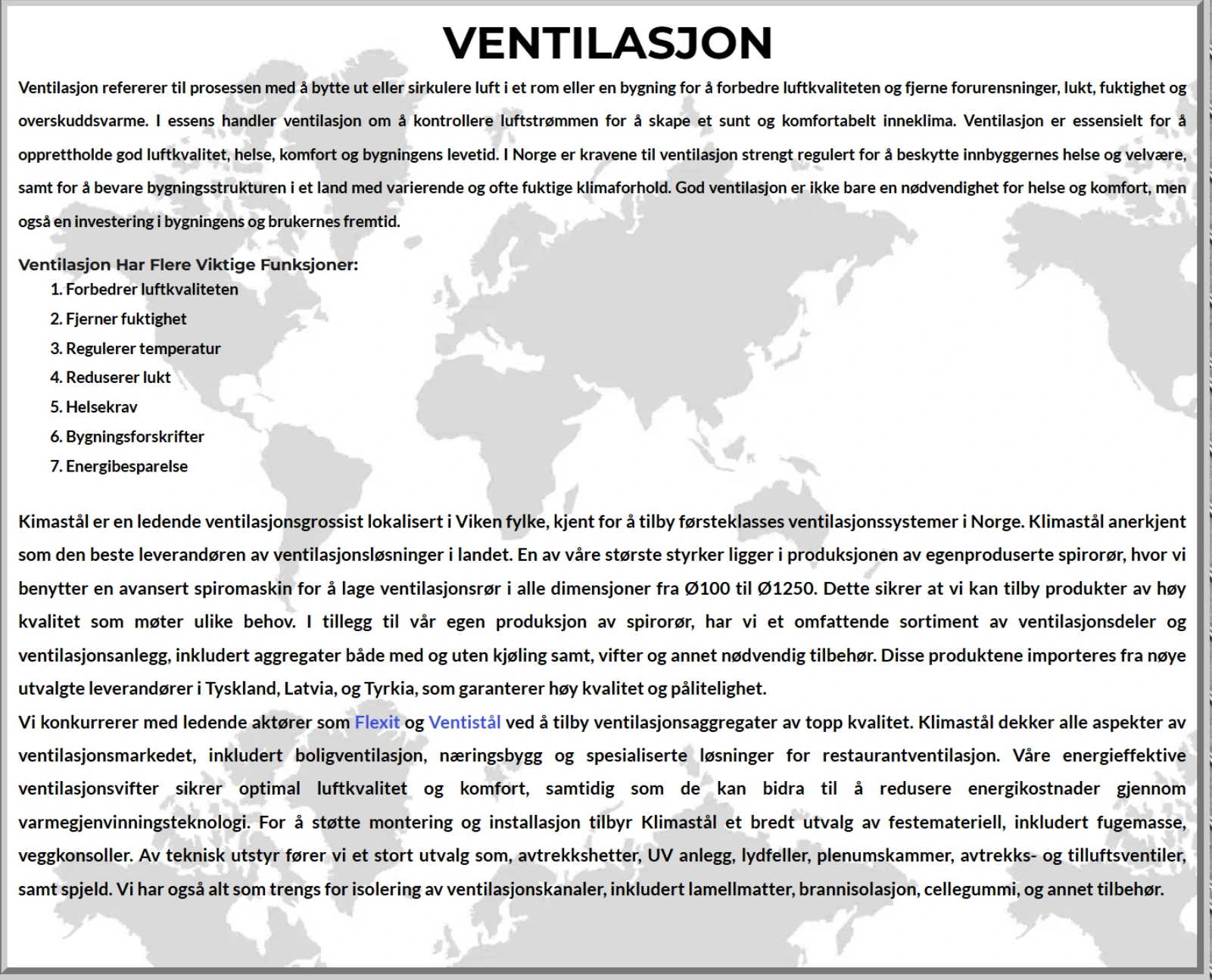
Homepage capture dated 2 June 2025. An explanation of ventilation and seven functions now precede the supplier description.
The later opening first explains what ventilation does, then lists functions such as supplying fresh air, removing moisture and regulating temperature. This gives a visitor an explanatory entry point before the company-focused paragraphs. It also creates a more scannable sequence than presenting all the material as supplier description alone.
English reading aid: the later section explains ventilation as replacing or circulating air to remove contaminants, odors, humidity and excess heat. It then introduces the supplier’s products and services. This is a summary translation of the Norwegian content, not a new customer claim.
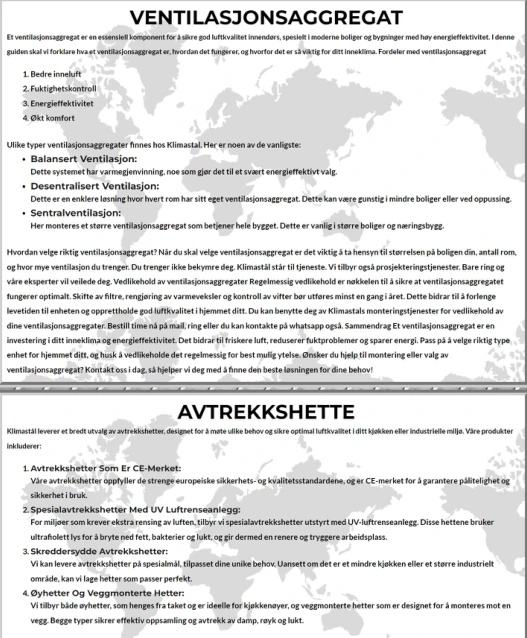
Additional category-copy evidence: ventilation units and extraction hoods, with subheadings and product-use information.
The content could still be improved. The captures show dense paragraphs, a visually busy background and opportunities for clearer product-to-enquiry links. In a new iteration I would keep the category coverage while simplifying the presentation, giving product selection and contact actions stronger visual priority. That is a proposed next step, not a claim that the captured design already implemented it.
Search reporting: the counts behind the percentages
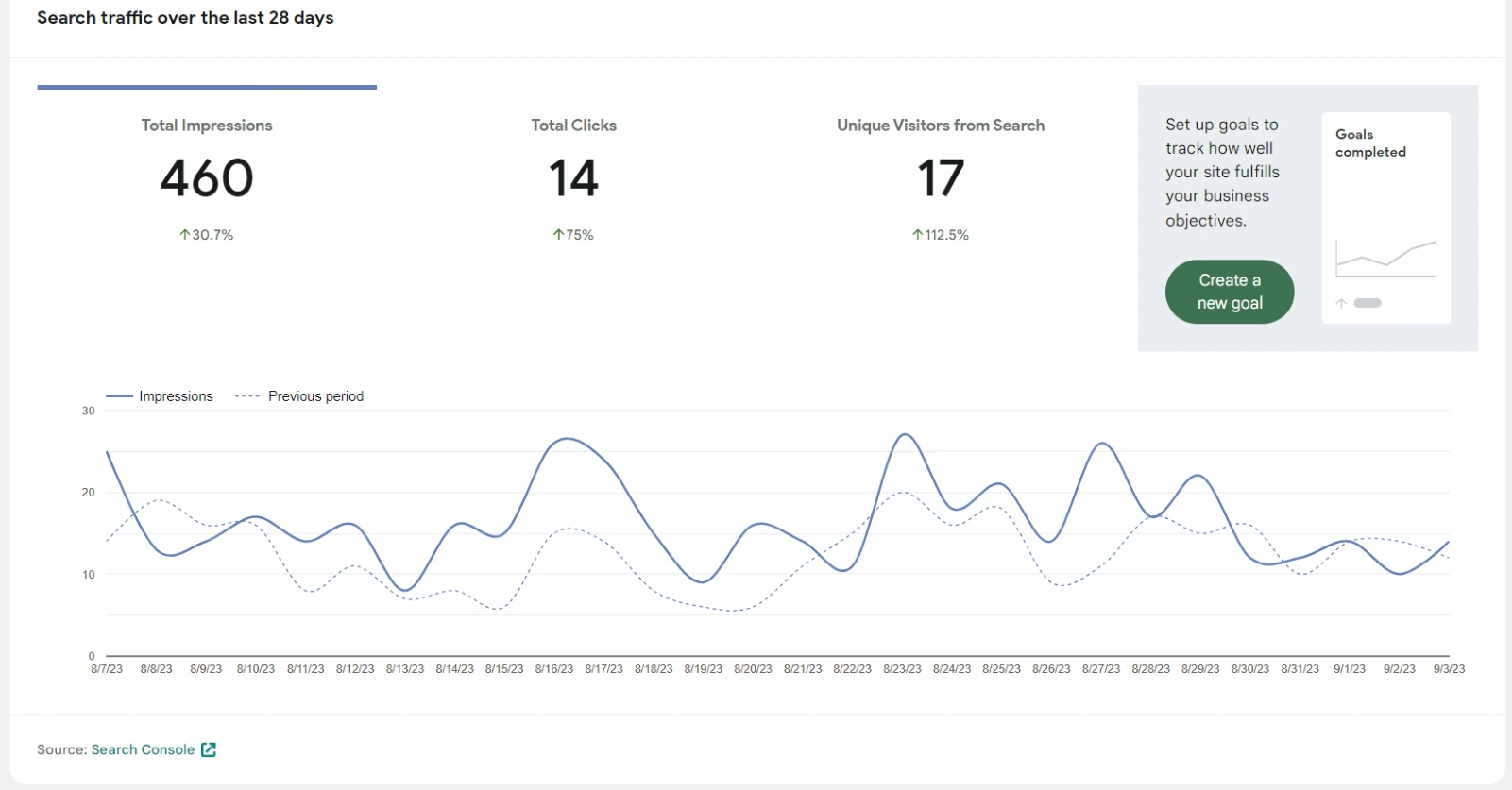
Historical Site Kit snapshot: comparison with the previous 28 days. WordPress administration and account controls have been cropped out.
| Metric shown in the dashboard | Count | Dashboard comparison |
|---|---|---|
| Search impressions | 460 | +30.7% |
| Search clicks | 14 | +75% |
| Unique visitors from search | 17 | +112.5% |
These are modest absolute volumes. Showing both counts and percentages keeps the scale visible: a large percentage change from a small base should not read like a large established traffic operation. Impressions represent visibility in search, not visits. Clicks and unique search visitors also come from different measurements and should not be treated as interchangeable.
This snapshot supports a statement about the displayed comparison window. It does not establish sustained annual growth, engagement-wide traffic growth, qualified leads or revenue attributable to the work. To assess those questions, I would need longer exports with consistent dates, filters and conversion definitions.
Research that supported the wider engagement
The prospect export contains 2,011 unique domains: 1,740 discovered only through competitor sources, 255 only through keyword sources, and 16 appearing in both source categories. Two copies of the same export were supplied; they have been counted once.
This is an operational research asset, not a backlink result. The next stage would be a relevance and suitability review, followed by clearly recorded outreach and placement outcomes. Tool-provided scores alone would not make a prospect appropriate.
Explore the research and reporting collection.
The engagement also included Norwegian promotional email and marketing creative. Those examples sit in a supporting collection so the main case study remains focused on the website and its evidence.
View the campaign design collection.
What I would carry forward
The most useful next step is a matched mobile retest, followed by a record of the precise changes made and a repeat test under comparable conditions. I would also preserve full-page content snapshots before future edits and record publication dates for metadata drafts. That would strengthen the connection between work completed and the observations made afterward.
The project demonstrates practical work across WordPress, content, research and reporting. Its strongest portfolio story is the combination of that work with inspectable source material—not a promise that one performance score guarantees search or business growth.
Related work: Ziyana Yachts diagnostic · Technical audit assignment
Have a WordPress site that needs investigation and practical updates? Discuss your website.