
seabrightheatingandcooling.com technical audit
This assignment investigated a reported ranking decline for an HVAC website. The purpose was to distinguish what the supplied tracking evidence showed from the explanations that still required testing, then identify the next checks and improvements.
Reporting window: 25 August–14 September 2026. Audit report: 22 September 2026. Access boundary: no Google Search Console or GA4 access; no website changes made.
This was a diagnostic assignment, not a client implementation or a ranking-recovery engagement.
Start with the reported movement
The supplied audit summarizes 21 tracked keywords: 15 declined, three improved and three were unchanged. Five keywords newly appeared as “Not found.” These are tracker observations. “Not found” means a term was not located within the tool’s checked results, not that the website was necessarily removed from Google.
The report also notes a concentration of ranked queries on the San Jose page: 14 of the 15 currently ranked rows resolved there, with the remaining row resolving to an installation page. That pattern made landing-page selection a useful diagnostic lead. It did not prove that the location page caused the earlier loss.
I would preserve the tracker’s device, location, checked depth and dates before comparing another data source. A change in those settings could affect the apparent movement and weaken any attempted comparison.
Separate current findings from historical causes
Actual findings excerpt, reflowed. Company identity and identifying headers are omitted from this cover; the project title and route intentionally name the site.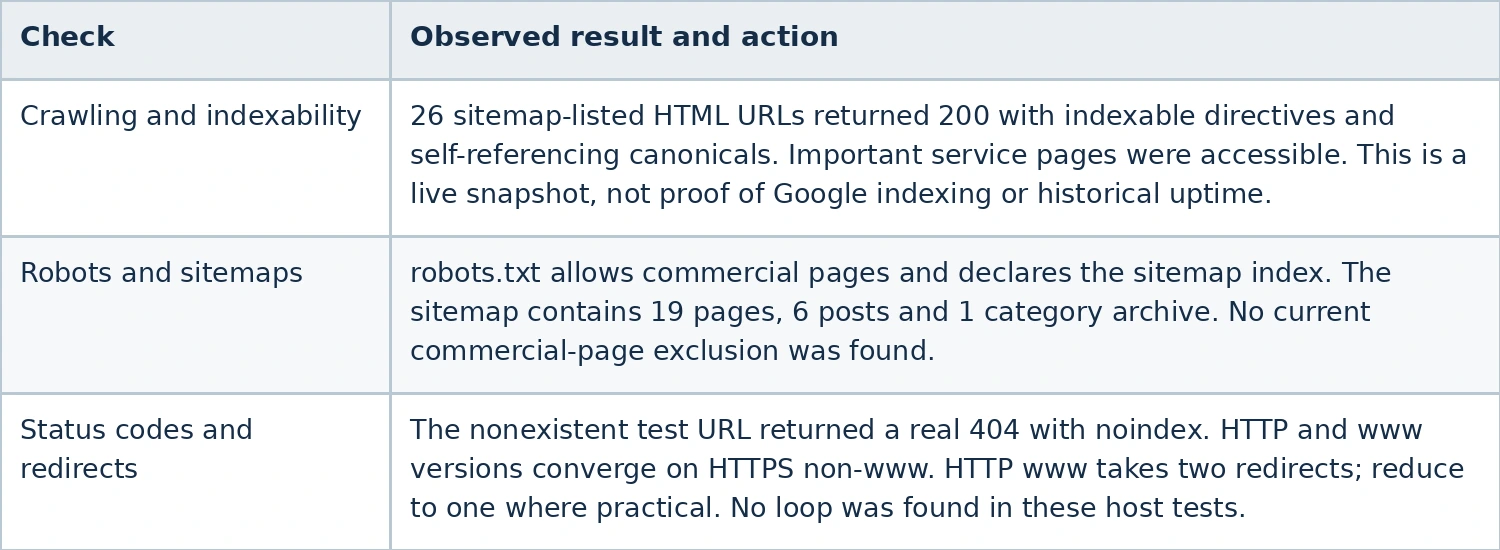 Open full size
Read excerpt as text
Check Observed result and action Crawling and indexability 26 sitemap-listed HTML URLs returned 200 with indexable directives and self-referencing canonicals. Important service pages were accessible. This is a live snapshot, not proof of Google indexing or historical uptime. Robots and sitemaps robots.txt allows commercial pages and declares the sitemap index. The sitemap contains 19 pages, 6 posts and 1 category archive. No current commercial-page exclusion was found. Status codes and redirects The nonexistent test URL returned a real 404 with noindex. HTTP and www versions converge on HTTPS non-www. HTTP www takes two redirects; reduce to one where practical. No loop was found in these host tests.
Actual findings-table cells from the supplied audit, reflowed. The excerpt omits the company name, domain and identifying headers. It records observations made at the audit date, not a new live check.
The report records that 26 sitemap-listed HTML URLs returned 200 at the time of review, with no current sitewide blocking directive detected. It also records more localized concerns, including utility-page indexing, internal-link opportunities and inconsistencies in structured business information.
These findings have different roles. A utility-page indexing issue can be worth fixing without explaining a sudden decline. Similarly, a slow page can warrant performance work without proving when or why rankings changed. The investigation should keep those two questions separate: what needs improvement now, and what evidence would explain the historical event?
Three competing explanations to investigate
| Diagnostic lead | Why it matters | What would discriminate between explanations |
|---|---|---|
| Landing-page selection and intent | Service queries appeared concentrated on a location page | Daily query-by-page data, intended service-page mapping and historical landing URLs |
| Historical technical or content change | The report describes changes after the tracking window, which can obscure the earlier state | Dated revisions, deployment records, redirects, logs and preserved crawls |
| Tracking and localization | Mixed tracking locations and “Not found” handling can affect interpretation | Original tracker settings, consistent-location checks and comparison with first-party search data |
This is a revised investigation framework based on the source report. It is not a newly established root cause. The source also discusses an industry pagination-access hypothesis. I would treat that as a hypothesis requiring primary evidence, rather than repeat it as a verified explanation for this particular decline.
A practical order of work
First, preserve the original evidence: the report, settings, affected queries and available page history. Request the missing first-party search data and change history. This makes it possible to test whether movement occurred across the site, a service cluster, or a small group of tracked terms.
Second, map each important service intent to its intended destination. The location page should help users understand local coverage; dedicated service pages should explain the actual service. Internal links and substantive service information can then be reviewed against that mapping instead of adding keywords indiscriminately.
Third, address confirmed current defects with a record of the change and a clear acceptance check. Correct business-information inconsistencies using verified facts. Review utility-page indexing based on its purpose. Preserve the form and tracking behavior when changing a thank-you page. Performance work should be retested under comparable conditions rather than assumed successful after a plugin setting changes.
These steps are recommendations from the investigation and this portfolio synthesis. The evidence does not show that I deployed them.
What a useful follow-up report would contain
A follow-up should show the original and revised date windows, consistent tracking settings, affected query/page groups and any changes actually made. A successful technical check is not the same as ranking recovery. Where data remains unavailable, the report should retain the uncertainty instead of replacing it with a confident story.
The assignment demonstrates diagnostic discipline: reading ranking evidence carefully, identifying plausible explanations, separating correlation from cause and setting out the next test. It does not claim recovered positions, traffic or revenue.
Compare with the implemented Klimastål work or return to Work.